 l’autre bande dessinée

Jérôme d’Alphagraph
«Va, petit livre, et choisis ton monde …»
Rodolphe Töpffer, Début de la préface de Monsieur Jabot, 1831
Jérôme n’a pas de parents. Il vit dans un palais oriental avec un vieux maître spirituel qui l’a élevé. Mais le temps est venu pour lui de partir à la découverte du monde et de trouver sa voie. Le décor est égyptien, l’amie de Jérôme s’appelle Sultana, on croisera un génie : le cadre est celui des contes des Mille et une Nuits (en un sens rien de plus logique, puisqu’il s’agit d’un feuilleton), le moule celui du roman d’apprentissage. Et pourtant nous ne sommes pas dans une pure fiction : car Jérôme est aussi le libraire de la librairie Alphagraph à Rennes, qui publiait la revue Chez Jérôme Comix où sont parus à un rythme hebdomadaire une grande partie des aventures de Jérôme d’Alphagraph.
Va-t-on alors nous raconter la naissance mythique de la librairie, éditrice du fanzine ? On pourrait le croire au départ, avant que le personnage ne s’étoffe et ne prenne son autonomie. De toute façon le chemin sera long, dans un récit qui ne craint pas les digressions (on est dans un conte oriental) et révère le goût de la flânerie (l’histoire est placée sous les auspices de Robert Walser). Jérôme part donc à l’aventure, en roulotte menée par un âne parlant, mais s’arrête au premier village, car il y trouve ce qu’il cherchait pour s’atteler à la réalisation de son rêve : devenir libraire. Une roulotte et une librairie : deux emblèmes contradictoires du nomadisme et de la sédentarité. Qu’importe, les livres permettent de les réconcilier : on voyagera immobile, et l’apprentissage et les expériences seront graphiques autant qu’existentiels.
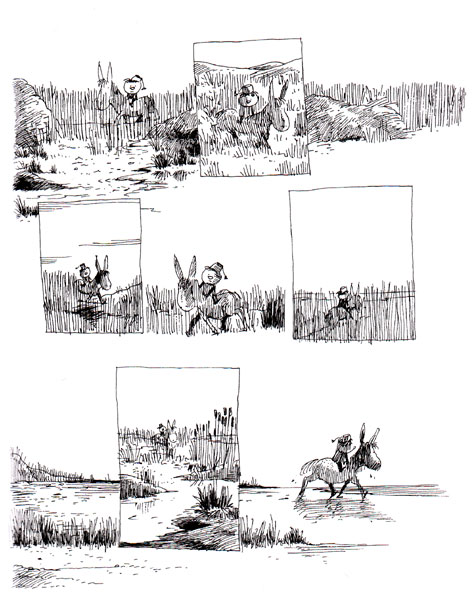
La bande dessinée a d’ailleurs les moyens de figurer les vagabondages de l’âme : en contrepoint aux scènes décrivant la vie de la librairie, les promenades de Jérôme l’emmènent dans un paysage bucolique et onirique, une nature apaisée et déserte, pour de longues conversations avec son âne ou avec soi-même. La mise en page éclate alors, se fragmente sur le fond d’un paysage en pleine page, un peu comme dans certaines sunday pages des Krazy Kat de Georges Herrimann. On pense aussi à Fred, son Petit cirque et son Journal de Jules Renard, pour les ambiances.
Enchaîné au rythme hebdomadaire, avec une intrigue assez lâche et très improvisée, le récit finit fatalement par refléter l’évolution de son créateur. Le personnage de Jérôme est une coque légère et fragile («sans mon fez par exemple, je ne suis plus grand chose», se rend-il compte dans Jérôme et le lièvre), tiraillée entre son origine anecdotique et les traits de caractères que lui impriment les hasards de ses aventures ; support de projection pour les amateurs de livres que nous sommes, il l’est aussi pour l’auteur — et au fur et à mesure la vocation d’écrivain de Jérôme s’affirme de plus en plus. Nous sont alors racontées, passées au filtre transfigurant de la fiction, les aventures de la création, ses enthousiasmes, ses doutes, son quotidien, ses à-coup.
Le tout est cerné par petites touches, sur le mode de la conversation, avec l’attente de sa reprise en guise de suspense. Le trait, précis pour les décors contemplatifs et esquissé pour les personnages (à la Bretecher), se cherche à travers une petite histoire devenue longue, tantôt sérieuse et tantôt désinvolte, bavarde et silencieuse, charmante de bout en bout. Elle est à déguster par épisodes, pour la laisser s’entêter, comme une petite musique qui prend progressivement possession de votre conscience et dès lors vous accompagne.

 Jérôme et la route
 Sieste en Guadeloupe












Super contenu ! Continuez votre bon travail!