 l’autre bande dessinée

Julien Boisvert (t4) Charles
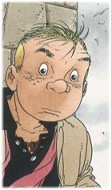
Le 4ème (et dernier) album de Julien Boisvert s’intitule Charles et dans sa 1ère édition il comporte un encart d’une dizaine de pages montrant des croquis de Plessix ou dévoilant la genèse de quelques planches. Le plus intéressant dans ce supplément, est qu’il se termine par un dessin de Julien Boisvert et son chien Gilbert imitant Tintin et Milou.
Ce dessin n’est pas là par hasard. Il n’est pas purement anecdotico-référentiel, postmoderno-historiciste du genre « j’y était » comme les photo de touristes devant un monument. Non ! il est là car la série de Dieter et Plessix est une relecture subtile de Tintin et de la vie d’Hergé ; une tentative de réponses aux questions qu’elles inspirent.
Aux reproches fait à Hergé dans sa façon de montrer les Africains et d’exalter la colonisation, Dieter et Plessix montrent la décolonisation et ses horreurs si Tintin/Hergé l’avait vécue/écrite.
A la temporalité de Tintin, à son éternelle jeunesse, à son absence de famille, de métier etc … (tout cela maintes et maintes fois souligné) ; Dieter et Plessix vont imaginer un Tintin/Boisvert clairement situé dans les années soixante et soixante-dix, qui va vieillir, avoir une histoire sentimentale et familiale, fonder une famille, etc …
A un Tintin qui va sans problèmes avec Milou en Angleterre dans l’album l’île noire (Eh oui ! c’était bien l’Angleterre, Hergé le confirmera en 66 …), Dieter et Plessix montrent comment un Tintin/Boisvert en vacances dans une île anglo-normande, serait/est obligé de cacher son chien Milou/Gilbert dans l’album Grisnoir [1] .
Mais Hergé à la manière de Flaubert a dit « Tintin c’est moi ! », Dieter et Plessix le savent évidement, et dans l’album Jikuri le Tintin/Boisvert fait place au Hergé/Boisvert. Si Jikuri doit être comparé à un album de Tintin, c’est à Tintin au Tibet qu’il doit l’être.
Cet album a été pour Hergé une thérapie alors qu’il devait choisir entre deux femmes. Dans Jikuri, Boisvert est dans la même situation, son coeur hésite entre Elena et Molly (avec laquelle il a vécue et eu un fils)) [2] .
Il y a aussi l’importance des rêves dans les deux albums, mais aussi celle du désert (blanc pour Hergé/Tintin), de la montagne, de la grotte, des statues, de la religion, des indiens, du piment, de la couleur, des rites, etc …
Avec Charles, Dieter et Plessix développent la relation fils/père, créateur/créature [3] . On y voit alors Boisvert découvrir un père qui selon toute apparences est le collaborateur d un groupe d’extrême droite (tendance KKK). Un peu comme si Tintin avait découvert Hergé au moment ou il était (injustement) accusé à la libération d’avoir collaborer avec les fascistes.
Boisvert/Tintin (nous) apprend (apprendrons) vite que Charles/Hergé est tout le contraire. D’ailleurs si Hergé avait été raciste ou fascisant il n’aurait jamais pu faire Le Lotus Bleu ou Le spectre d’Ottokar (où Tintin sauve la monarchie parlementaire Syldave (même régime que la Belgique) d’une tentative d’Anschluss par un certain Mâsstler …)
En fait les deux premiers albums d’Hergé sont le reflet d’un jeune homme des années 30, immature intellectuellement, influençable et d’une Belgique (et d’une Europe même) colonialiste …
Ces allusions constantes (conscientes ou inconscientes) à l’oeuvre Hergéénne sont renforcées par le style de Dieter et Plessix.
Dieter construit des scénarii allusifs et pleins de non-dit pour nous piéger dans nos spéculations sur le déroulement de l’action. De même, Plessix construit des cadres étroits, distendus ainsi que des gros plans favorisant le hors-champ.
Cette petite démonstration est bien sûr imparfaite, et demande à être mieux étayée (peut être est-elle victime de ce style allusif des deux auteurs ?). Mais son seul but est de vous inviter à lire Julien Boisvert dont l’intégrale est désormais disponible.
Notes
- Gilbert a un nom d’humain, mais il ne parle pas, ne pense pas et ne boit pas du Loch Lomond comme un humain … ou comme Milou (qui a pourtant un nom de chien).
Gilbert est un chien qui n’obéit pas bien, fait des bêtises, est gourmand, chapardeur et n’est pas insensible aux poussées hormonales (chaleurs) de la saison des amours … et c’est en cela qu’il est plus humain que Milou. - On notera que Julien Boisvert à la différence d’Hergé retournera avec sa femme, car la série de Dieter et Plessix s’interroge d’abord et plus consciemment sur la question de la temporalité du héros de bande dessinée dans la tradition franco-belge (que symbolise Tintin).
- Interrogation récurrente dans l’oeuvre d’Hergé. Voyez les Quick et Flupke des années 30, dans une histoire intitulée « une grave affaire » par exemple (Archives d’Hergé t.2, p.146) Hergé a dessiné un gag où il est kidnappé par les deux garnements qui veulent prouver au monde (incrédule) qu’ils sont en vrai gentils et sage …
Et en paraphrasant Flaubert vers la fin de sa vie, Hergé ne fait que confirmer l’importance de sa propre histoire dans les aventures de Tintin (en particulier par sa relation avec Tchang) et renforcer ainsi le lien du créateur avec sa créature, artefact d’un lien père/fils qu’il n’aura jamais vécu en tant que père, à son grand regret (voir entretiens avec Numa Sadoul).

 Vieux Fou !







Super contenu ! Continuez votre bon travail!