l’autre bande dessinée

Shissô Nikki
Following his debut in 1969 with Manga-Oh, Azuma Hideo had worked through twenty years of an honest manga-ka career, not necessarily in the spotlight but far from being totally unknown, with gag-manga and science-fiction series (receiving on the way the 10th Nebula Price of the Japanese Science-Fiction Society for Fujôri Nikki), and occasionnally dabbing in the midly erotic.[1] Acknowledged influence of Anno Hideaki (the Evangelion creator), boasting a bibliography counting over 80 books, one could easily expect him to carry on his tranquil little way. But.
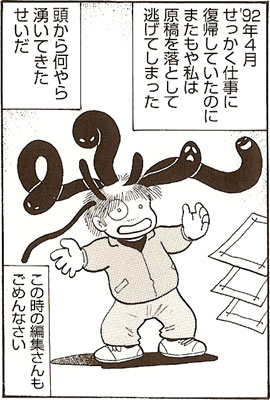
In November 1989, Azuma Hideo left abruptly his wife and his manga-ka career to live as a homeless in the parks — a first experience that will last for two months. April 1992 marked a second stint, which would ultimately lead him to work for over one and a half year for a public works company, as a rehabilitation program. Eventually, during the Christmas celebration of 1997, the first delirium tremens crisis would lead him to enter a detox program for more than six months in order to cure his alcoholism issues. Published in 2005, Shissô Nikki (“Disappearance Diary”) gets back to those three experiences, in as many corresponding chapters — “Yoru o aruku”, “Machi o aruku” and “Al-chû Byôtô” (respectively “Walking in the night”, “Walking in the city” and “Alcoholics Ward”).
With his deceptively round and simple line, Azuma Hideo traces back his steps during those difficult moments, without sparing anything, but without falling into miserabilism. Quite the contrary, with a book that focuses on a more factual approach, detailing the process of learning how to survive on the street, the little strategies, the smll victories — but also the moments of shame. If the first two parts of the books echo and complete each other (“Yoru o aruku” is about learning the street life, while “Machi o aruku” follows the path back into society), the reasons behind those “disappearances” will only be evoked about two-thirds into the book, in a sequence follwing his career as a manga-ka, talking about the difficulties of communicating with his editors, mentioning the ever-present pressure to produce, and giving in the process a little outlook on the industry as seen from the inside.
If this sequence is a way to bring closure to the first two parts, things are very different with the last part. Evoking his dependency to alcohol and his slow downfall (with hints of self-destruction), Azuma Hideo concludes this collection on a positive note that might not be definitive.[2]
If it is difficult to remain indifferent to this story, the traditional question stays — the question of a diary as seen as an integral work, but also regarding its relation to the facts it relates, with a distance (in time but also on the psychological level) even more important because of a support (here, the comic form) which production takes time.[3] Azuma Hideo is clearly aware of this, as in the opening pages of this book, he addresses the reader to explain that all that follows is told in a positive light, and that he had to sacrifice some realism to avoid putting out a book that would be too dark. The interview with Tori Miki that serves as a postface brings another lighting on this :
“- Even during your disappearance, you managed to remain objective ?
– No, I had other things on my mind. (laugh) I thought I was going to die because of the cold. (laugh) But that was because I hadn’t had any sleep for a week … and after coming back from my disappearance, I thought I would use that as a line, and I drew in my notebook : “It was so cold I could die”. And the morning after, I found that my wife had written after that : “… here, I was feeling even more miserable”. (roaring laughter)”
But even despite this “controled narrative”, this raw retelling reveals its therapeutical value, as if the fact of writing down this long climb back up (up to the most minute details of the daily routine) was a way to give it an added reality — to better turn the page and put it away. This is more obvious in the somewhat duller moments of the books, where the author goes to great lengths to explain the different techniques to cut off a gaz pipe, or studies for a plumbing exam.
Beyond these little defaults, Shissô Nikki remains an unique account, with an author baring it all in an approach reminding of Mattt Konture or Joe Matt (without the bragging). And with one masterful stroke, Azuma Hideo gets back in the spotlight…
Post-Scriptum : Let’s note that the publication of this unique work hasn’t remained unnoticed, and has been rewarded in Japan by no less than four major awards : : the Dai-34-kaime Nihon Mangaka Kyôkai Shô Taishô (34th Grand Award of the Japanese Association of Manga-ka), the Dai-9-kai Bunkachô Media Geijutsusai Manga-bumon Taishô (9th Grand Prize of the Arts Festival of the Media and Cultural Affairs Agency, Manga category), the Dai-10-kai Tezuka Osamu Bunkashô Manga Taishô (10th Culture Award Tezuka Osamu, Manga Grand Prize), and the Dai-37-kai Nihon SF-Daikai Seiunshô Nonfiction-bumon (37th Nebula Prize of Japanese Science-Fiction, Non-fiction category). Obviously, in Japanese, it’s always a mouthful.
Notes
- He is at the origin of the Lolicon Boom of the 80s, with series like Shôjo Alice or Junbungaku Series, the first time an author from the major periodicals turned to the erotic field.
- The answer to that is most certainly in this book’s follow-up, Utsu Utsu Hideo Nikki, who boasts the same bright orange cover and a similar approach of a minute accounting.
- Note that the publication (and most likely, the production) of this book went through three stages : publication of part of “Yoru o aruku” in 1992 by Ohta Shuppan ; serialization of “Machi o aruku” in 2002 in the periodicals O-Takara Wideshow and Core Magazine ; and finally this book published in 2005, completed with Al“-chû Byôtô” and some unpublished pages for the firt parts.