l’autre bande dessinée
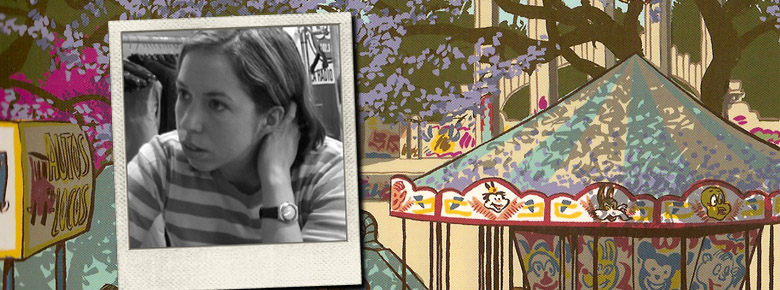
Jessica Abel
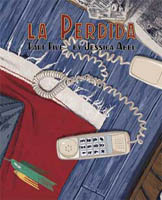
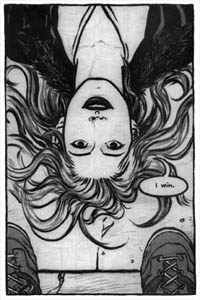
Early 2005, Jessical Abel’s most imposing work to date, La Perdida, came to its conclusion five years after its debut. Taking advantage of a French translation published by Delcourt, meet the artist who remains the ArtBabe in chief — or not.
Xavier Guilbert : We’re going to start with the start — sort of. You received a Xeric Grant back in 1995, about ten years ago. How do you look back on those past ten years ?
Jessica Abel : They were pretty good. You know, the interesting thing about my carreer is that, when I started after college in ’91 or whatever, I had no idea … I knew I wanted to do comics, but I did not have an idea how one would do that, what it would look like to be a cartoonist. What would you do with your day ? Like how would you get paid ? You know — I had no idea. Especially at the time, in the American comics industry, unlike here, there was no way. Unless you were doing superheroes, which I wasn’t. So, looking forward, it was very dim, and I had no idea. But looking backwards, it looks like a totally straight line, I mean, like done with a ruler. You know — mini-comics, then I won the Xeric Grant, then I did the individual issues, then I did the book collections of those and I did another — four of five graphic novels, and I’m pretty happy about it. All those things were important stages and I couldn’t have set myself on that path intentionally.
XG : Following the Xeric Grant, why did you decide to put an end to the ArtBabe comics ?
JA : Well, I was living in Mexico at the time, and I did two issues of ArtBabe while I was in Mexico and … after a while, it felt very strange. Because I was living in Mexico and … writing about people in Chicago sort of living their relatively quiet life and having their small quiet mid-western crises — meanwhile, I was trying to learn how to speak, just to communicate. The problems I was having, sort of … I mean, I was having a really good time, but the things I was dealing with in terms of friendship and communication, the things I was learning, the things that were changing for me — were so much bigger than that. And it really felt alien to me. That life felt very far away. So — so I stopped.
And also I was having a problem with the drawing style. I wasn’t enjoying drawing that way. And so I was also trying to think about a new drawing style. So I did a lot of work to figure out how to draw. And between ArtBabe and La Perdida, I did a non-fiction comic called Radio : An Illustrated Guide …
XG : And the stuff in the University of Chicago Magazine …
JA : I did that for ten years or something. I did that for a long time.
XG : Those were one-pagers, color, with a more journalistic approach …
JA : Right, but I did those every two months, for about eight years. So that went all the way through everything. But the Radio book was a three-four month period where that’s what I did. Very intense project … because it’s a very complex book, with many many … sort of levels to it where I can make many things happen at the same time. It was a really fun project, but it was a lot of work. So it was a good break because it really set me aside from fiction comics entirely, and I could clear my slate and be ready for something else.
XG : It’s interesting you say you had to move away from ArtBabe, because from a reader’s point of view it very much feels like an area of experimentation, from the early stages of the mini-comic where sometimes you did things in prose, or the more recent ones, where you work with like pastel, or …
JA : Dry brush.
XG : Did you feel that this format was something to , and experiment with ?
JA : Well originally, Perdida was going to be ArtBabe volume 3, but called “La Perdida” — sort of, you know, under that heading. But the actual … well there’s two things. One is I think that over time, I had narrowed my choices to “am I gonna do dry brush or not dry brush ?” Like the stories, people were expecting a certain kind of stories, and especially a certain kind of settings, and the kind of people who were going to be there — all that stuff was sort of like, you know … there were a lot of expectations of that.
The second is that the title of the series implies a certain kind of thing. I didn’t want to be restricted by that. You know, it sounds very cheeky and cute, and I was getting tired of that. It has done very well for me, it was a really good title because it called people’s attention, people would remember it … and buy it. So you’d get the thing — I mean, I always had the thing where everybody would go “Oh, ArtBabe” you know, and call me ArtBabe, and then I’m like : “Why would I put me on the cover of my comic book ? Who would do that ? Like I don’t do it, that’s no me.” And then they would say : “Oh yes it is you, it is you”, and you have arguments about it where like “Okay, it’s me, whatever”. It just felt very much like I was the feature, I was the big issue. I wanted to put myself further away from the content of the book, and make it more cleary fiction.
What is really funny is that people now think I’m Carla so — that’s even more embarrassing. I mean ArtBabe, at least she’s cool, she got things in control, you know. Carla is just an idiot, so … (laughs)
XG : Is that also the reason why you changed the website ?
JA : It is, it is. I mean, I kept the website for a while, but ArtBabe was only one of the things that I did. And calling it “ArtBabe” — well, the website “ArtBabe” — meant that I had to put my teaching under “ArtBabe”, and the educational stuff I’m doing, and the non-fiction. And so, I really wanted, you know, that ArtBabe is only one of the sections under … (laughs) It makes more sense ! I’m not ashamed of it. I like it, I mean, I’m glad I did it. It definitely has to do with me in my twenties, you know.
XG : Moving to La Perdida — you mentioned that you did the last two issues of ArtBabe while in Mexico, you started working on La Perdida when you got back in the US. When did the idea for La Perdida came up ?
JA : While I was in Mexico — I mean, let me just say, the seed of it. The basic idea of it. And then I think I got some of the main plot points when I was in Mexico. I took photographs, you know, I had an idea of what I was going to do. But the hard work of sitting down, and working out all the kinks and figuring out what it was going to be, was when I got back.
XG : Did you make sketches, took notes about the storyline while being in Mexico, or was that something that came afterwards ?
JA : No, I did … I did some sketches, I thought about the characters, I did some writing about characters, did a little bit of development work. But I really did start after I got back. I didn’t feel like the time, I didn’t have the time to really think about it, and only got the time when I got back. I would have if I wanted to, while still in Mexico, but … it didn’t work out.
XG : So this wasn’t something about you want to distance yourself from the subject ?
JA : No, it wasn’t conscious at all, no.
X : You mentioned that a lot of people where thinking that Carla was you. Even if La Perdida is obviously non autobiographical, there’s still the feeling that you wanted to share of your experience of Mexico …
JA : I think at a superficial level that’s true, I mean I think that on the level of, this is a really cool city and it’s really beautiful and there’s stuff you can do and things you can see and people you’ll know who are really interesting and it’s worth it, you know, that you should come. That part is from me. And the various places that I really liked, I made sure to draw them. (laugh) You all have them in there. So yes, there is definitely a personal touch, and I could not have done this book just by visiting for a couple of weeks — I had to live there.
XG : The fact that she has to learn Spanish …
JA : I did that too. I mean, I didn’t treat it the same way she did, but the school that she first goes to, I first went to. You know, I mean again, I’m using the details that I learned about in my experience there. And one of the thing about the book is that it’s written in the first person and that’s partly why it’s confusing. But it’s written in first person intentionally because I’m acknowledging through that that I can’t possibly know what really happened in Mexico when I was there. I know my experience, but it’s such a different culture. You know, there’s probably all kind of things that happened — I probably hurt everybody’s feelings, did everything wrong, and misunderstood everything that people said to me. You know ? On some level that’s true, and the day I got over it was fine, but you’ve got this … it has to be the point of view of a stupid American, or I can’t write this book.
XG : La Perdida is long-spanning narrative — a big change compared to the short stories of your previous works. Why did you want to move away from that ?
JA : The main reason I wanted to do that was that I wanted to … the way a story is structured is that you have a character, and you throw a problem at that character. And they have to — solve it, you know, they can do something about it, fix it, but they have to do something. And in a short story, you tend to have a vignette idea about it. Sort of like, you have a little window into a segment of this character, you see them — like in most of the ArtBabe stories, for example, you have a character having a realization, like “oh ! that is what the problem is”. Instead of actually fixing the problem, you have this moment of quiet like … “ah !” You know ?
And when you have a novel-length work, the kind of issues you can throw at characters are so much bigger and the things therefore that you learn about the characters because that’s how you learn about characters too, it’s much deeper. You can do much more with it. And I really wanted to do that, I wanted to … up the ante. To do, to have a character where I was able … I would be able to push her harder, and to see what I could find out. I also have a complete story-arc where you have a problem that happens and you have the resolution of that rather than just an indication of which way it might go. You can actually wrap it up.
XG : So when you started working on La Perdida, you had a definite conclusion in mind, the way things where going to evolve ?
JA : Yeah, basically I didn’t know any of the details, but I knew sort of the main plot points before I started. And I worked on each book separately. You know, write and then draw chapter one, then write and then draw chapter two. Certainly while I was writing each chapter I was filling in details for the future ones. So by the time I drew — I wrote chapter four and five and finished it, and then drew one and then drew the other. But the earlier ones had a much bigger gap between, which I think shows actually in the book so I had to do a lot of reworking to get them to just run a little bit more smoothly.
Artistically, it would have been better for me to do it all at once — you know, do all the sketches, then draw it all at once. But it’s just — just too hard. You know, I need deadlines, I need feedback, and kind of an engagement with the world about it I think.
XG : There was a big change in the art between ArtBabe and La Perdida.
JA : Yeah.
XG : You said you wanted to change the way you draw. How did that realization came up ?
JA : Well, I was feeling really really frustrated with the ArtBabe style and … so tight, so like of tightly controlled and careful, and it was … it was really difficult for me to … actually physically do that. I felt like really drained by it and then frustrated by it. So I would finish a page, and it would never be like : “Oh, that’s nice”. I would feel like — you know, terrible, like “I don’t like that. There’s all kind of things that are wrong, that perspective — you know, foreshortening is terrible and that perspective is off … there’s no detail in the background …” In my mind, it would be more fully realized than I could actually achieve in this very … realistic style.
So what I wanted to do is take a couple of steps back from that and say : “Okay, well how can I imply the richness that I think should be there without actually drawing it”. So I think that’s actually what the style does, there are markings in the background that you, the reader, resolve into rich background space. I’m not drawing all the things because I can’t possibly — you know, I couldn’t possibly actually deliniate everything that needs to be there. But I can kind of get you to imagine it — in your head, it’s richer than it is on the page. So that’s one advantage.
The other one is speed. The pages of ArtBabe took me, you know … ten or twelve hours, now they take me five. It’s like, a really big difference. It’s litterally much smaller, ArtBabe is a little like this (A4 format), and Perdida is about like this (nearly the size of the comic book) so … I feel more confortable working small, I think that’s another thing that I figured out when I was working through this process of how I’m going to change my style and experiment with redrawing pages big and then redrawing them small and photocopy them all to the same size and compare them. And I realized that the smaller one looked better, had more of the feel that I wanted, so I started drawing small. Litteraly what I was doing was like a series of drawing exercises to figure out what kind of choices I wanted to make.
XG : La Perdida is about finding one’s own identity. That’s a subject that was already present in ArtBabe in a way. Is that something that is very important to you ?
JA : I think it’s very important for a vast majority of people, especially young, middle-class westerners. “Who am I, and where do I belong, and do I have a claim on anything ? Do I only get to live in suburban houses, and working anonymous office jobs, or something more genuine than that ?”. I think that’s the challenge that we all have, and when I got into music, you know, and stuff like that when I was a teenager, I went to rock shows and played in a band and did all that stuff, it was because of the music of course, but also it gave me an identity that I was confortable with — cool and tough and real and I did something … awesome. (laugh) And that’s the same thing with the ArtBabe characters, like they … they’re trying to state a claim for themselves as being something authentic while feeling like fakers. You know, they feel like — I think this is essential to middle-class youth. How do you feel, like you deserve to really be that thing or to present yourself in that way. Avoid being a poser, you know, it’s ridiculous. Just do what you want to do. When you’re twenty-five, you’re like very concerned with “Do you look like a poser ? Are you really a poser ?”. You sit home at night, you know — “Am I a poser ?” (laugh) I imagine that occuring here too. (silence) I don’t worry about it so much any more. (laugh)
XG : Has your teaching at the School of Visual Arts changed the way you approach making comics ?
JA : Well, teaching and doing educational stuff is something that is very important to me. It’s been a long time — I mean, I’m sure you’ve seen my website ages ago, I already had a little teaching section on it. And it’s always been important for me. So the teaching is fun for me, I really enjoy it a lot. I mean, it has helped me to clarify my ideas about story, like about how you develop stories, and to … helping kids to figure out how — well, they’re adults, but, you know — understand how the whole thing works out, how to get the work done, or like how to approach coming up with a new story, or how to think about composition, all kinds of things. And as I have to verbalize those things, it does help me to understand my own ideas. I don’t think I’ve changed that much. But definitely, it still … it helped me think a little bit more.
XG : There are a couple of artists — yourself, Matt Madden, James Sturm — who emerged in comics during the mid-90s, with Black Candy, ArtBabe …
JA : Coming from the mini-comics scene.
XG : Right. All three of you turned to teaching …
JA : There’s also Tom Hart, and Nick Bertozzi. They’re both teaching also there. So there’s a whole generation, you know, people who came out of minicomics, there’s a lot of people who are getting into teaching.
XG : And at the same time, their output somehow disminished compared to other cartoonists who remained more active. Do you feel that teaching limited what you wanted to do ?
JA : No, I — I mean, it certainly does disminish the amount of time I could devote to comics, but I never actually devoted all my time to comics. Before teaching, I was doing a lot of illustration, there’s always been other things that I did. The thing with James, is that he’s starting his own school, running a school, you know, from scratch. So yeah, for James, it has changed things. But I spend much more time now on comics and on the sketchbook that I’m writing on my novel or creative work than I ever did. But, you know, I’m not working on comics right now, so, you know, when I look back to it later, I still … I only teach two days a week, I don’t teach all the time. So it’s not a matter of time constraint.
XG : Moving to your influences and interests. It seems you are a big fan of Jaime Hernandez …
JA : Yeah, he’s really … he’s better than he ever was, he’s amazing.
XG : Did you follow what he did in the New York Times ?
JA : Yeah, it didn’t mean it was his most accessible story, I have to say. But, the most recent stories in Love & Rockets are really really good, they’re very subtle, very interesting. The unfortunate thing is that he’s so difficult for new readers to get into. Very difficult to say, you know … and I can’t just say “oh just pick up the last issue of Love & Rockets” because you’re not going to get it, you’re not going to understand like what’s going on, what the subtexts are. You have to really, you know … it’s like reading Proust or something, you have to read the whole thing. You can’t just like jump on at some point and read like, chapter 155.
XG : What about other cartoonists ? Well, besides Matt Madden, obviously.
JA : Huge influence ! (laugh) Should I give you other cartoonists ?
XG : Well, people you are interested in, people whose books you’re looking forward too …
JA : Tell you this, the book I’ve been most excited about in the last six months is Fun Home, by Alison Bechdel — it’s amazing. That book is soo good, and it completely came out of left field, I had no idea that was coming. She’s been doing a strip for ever, read a little bit of it, liked it — you know, it’s good. But this book is just — so good. So in the circle of new productions I think that’s like the highlight.
I love Kevin Huizenga. One of the younger people I like a lot is Gabrielle Bell who is in Mome and stuff, you’ve probably seen her there. She doesn’t have much of her own — she’s got a couple of collections but they’re hard to get.
And I try to read comics that are coming out — I like Anders Nilsen. He’s not as good as Huizenga I don’t think, but he’s really an influence and … I read Kramers Ergot, it’s interesting, there is stuff that I like more than other, Dan Zettwoch I think is really good. He’s pretty underappreciated, his style is a little bit like beautiful, but his work is really good I think.
Bernie Weinstein is good. They’re not influences, but when I was younger when I’d get something like that I would read it and like, absorb it and it would certainly make its way into my own work. But I think that after a while, you sort of have your things set up, and you read other stuff and you really enjoy it but it’s not going to change what you’re doing.
XG : So you’re still interested in comics, it’s not just a professional interest coming from being a teacher at a visual school ?
JA : No, I love comics. They are still very interesting to me, I got like this many books in Spain, finally getting all the Muñoz and Sampayo stuff in Spanish. Muñoz is a really important influence for me. You know, getting all the Max stuff, and … no, I love this stuff. There are certains things that I do try to keep track of, as a teacher. I do like a lot of manga, but I don’t know manga. And I always try to learn more about what’s the new stuff, so that I can talk to my students about it. It’s not painful for me, but it’s not something I would automatically go out and do. So there are things that I’m doing that way, but certainly not when you’re talking about something like Kevin Huizenga. I wait for the new book, then I run out and get it.
XG : Getting back to your upcoming projects, it seems that you’re moving away from the identity theme…
JA : Yeah. I mean I think there’s always that … that trying to be real, to connect with people. To get beyond your own emotional limits or whatever, something you know … a lifelong attempt to. There’s all kind of people I know who are in their sixties or fifties and that are total fakers and you don’t want to talk about. You know ? But mostly I think the next thing that I’ll do will be with people a little bit older and have different kinds of concerns. I don’t know, maybe not, but … I think so.
XG : The two books you have coming next year seem to be for a younger audience. There’s this teenage novel, Carmina …
JA : Yeah, I’m not done with it yet, so that’s not going to be next year, but yes.
XG : And the other one, Life Sucks, you only do the script …
JA : Yeah.
XG : Was that something you wanted to try ?
JA : Yeah, I mean, I enjoy doing it, it’s not a book that I thought that I needed to draw. Really, a more commercial project, a little bit. I really like it, but it’s not — I didn’t feel like, it needed to be me. Oh, you know, it’s funny, a comedy.
XG : Any other projects in the pipeline ?
JA : I have other projects that I have in mind, but I am working on a textbook right now about, you know, making comics. That’s taking up all of my time. That and finishing Carmina is my main thing for now. But there’s two things that I have in mind after that are the things I’ve talked about that are more like with older characters and sort of dealing with different stuff. But yeah, I mean it’s true.
And Carmina, I’m not particularly concerned with this idea of identity, authenticity. It is about identity because she comes from a different place, and she’s trying to make up a life for herself in Brooklyn. But she’s pretty confident about herself, it’s more about popularity and stuff than it is about what will really make her a player or something like that. And Life Sucks … is also not deeply concerned with the idea, the authentic life. I mean they’re vampires so, you know. (laugh)
XG : Looking to the future, no plans of moving abroad again ?
JA : I’d certainly like to. But I’m tied, for this time. The older you get, the more you build up your life and the connexions and everything. You have a house, and you know … but I hope we’ll do that.
(Interview made in Paris, on September 22, 2006)